

Diastasis Recti: How Pilates Can Help You Rebuild Strength from the Inside Out
Whether you’ve recently had a baby, experienced significant weight changes, or simply noticed a “pooch” that won’t go away despite exercise, you may be dealing with diastasis recti. The good news? With the right approach, you can improve core strength, stability, and function—and Pilates is one of the safest and most effective ways to begin.
Let’s take a closer look at what diastasis recti is, why it happens, and how Pilates can help you recover.
What Is Diastasis Recti?
Diastasis recti is the separation of the rectus abdominis muscles (your “six-pack” muscles) caused by stretching and thinning of the connective tissue called the linea alba.
While it’s most commonly associated with pregnancy, it can also occur in:
Men with increased abdominal pressure or obesity
Individuals who frequently lift heavy weights without proper core engagement
Those with chronic coughing or constipation
People who have experienced rapid weight gain or loss
A small separation during pregnancy is completely normal. The growing uterus stretches the abdominal wall to make room for the baby. However, for some people, the separation doesn’t fully heal on its own.
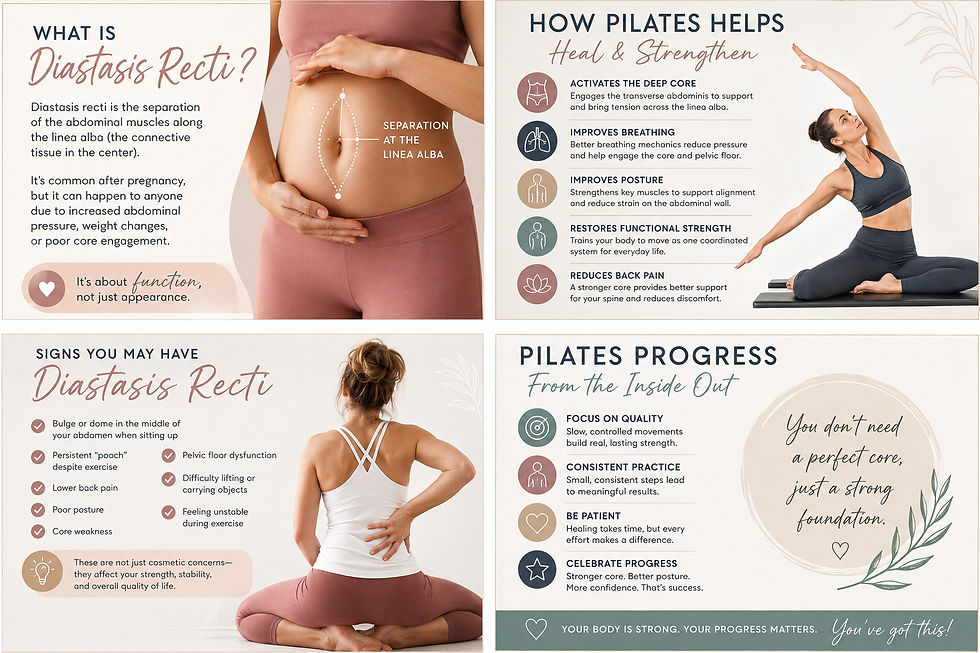
Signs You May Have Diastasis Recti
You might notice:
A bulge or dome in the middle of your abdomen when sitting up
Persistent “mom pooch” despite exercise
Lower back pain
Poor posture
Pelvic floor dysfunction
Core weakness
Difficulty lifting or carrying objects
Feeling unstable during exercise
Diastasis recti is about function, not just appearance.
Why Core Strength Matters
Your core is much more than your abdominal muscles.
It includes:
Transverse abdominis (your body’s natural corset)
Multifidus
Pelvic floor muscles
Diaphragm
Obliques
Deep spinal stabilizers
When these muscles work together, they:
Support your spine
Improve posture
Reduce back pain
Improve balance
Enhance breathing
Make everyday activities easier

How Pilates Helps Diastasis Recti
Pilates focuses on quality of movement rather than quantity. Instead of endless crunches, Pilates teaches you how to recruit the deep stabilizing muscles that support healing.
1. Activates the Deep Core
The transverse abdominis acts like a natural abdominal brace.
Pilates emphasizes:
Gentle abdominal engagement
Breath control
Core stability
Controlled movement
This creates tension across the linea alba rather than increasing pressure against it.
2. Improves Breathing Mechanics
Proper breathing is one of the foundations of Pilates.
Breathing helps:
Coordinate the diaphragm
Activate the pelvic floor
Engage deep abdominal muscles
Reduce unnecessary pressure inside the abdomen
Learning to breathe correctly is often the missing link in recovery.
3. Restores Functional Strength
Rather than isolating one muscle group, Pilates trains your body to move as one coordinated system.
This improves:
Standing
Walking
Lifting
Carrying children
Exercise performance
Daily activities
4. Improves Posture
Poor posture can increase strain on weakened abdominal tissues.
Pilates strengthens:
Upper back
Glutes
Deep neck stabilizers
Core
Better alignment means less stress on the abdominal wall.
5. Reduces Back Pain
Many people with diastasis recti experience low back discomfort because the spine lacks adequate support.
As deep core strength improves, the spine becomes more stable, often leading to reduced pain and improved movement confidence.

Exercises That Are Often Helpful
A Pilates instructor trained in rehabilitation may include exercises such as:
Diaphragmatic breathing
Pelvic floor activation
Transverse abdominis engagement
Pelvic tilts
Heel slides
Toe taps
Marching
Modified bridges
Quadruped arm and leg reaches
Supported leg work on the Reformer
Every program should be individualized based on your assessment and current level of function.
Exercises That May Need Modification
Not every abdominal exercise is appropriate early in recovery.
Depending on your condition, you may temporarily avoid or modify:
Traditional crunches
Sit-ups
Double leg lifts
Full planks
Heavy twisting
High-impact jumping
Exercises that cause abdominal “doming” or bulging
The goal isn’t to avoid these movements forever—it’s to build enough control and strength to perform them safely if appropriate.

Pilates Is About Progress, Not Perfection
Healing from diastasis recti isn’t measured solely by closing the gap between the abdominal muscles. Research suggests that improving the tension and function of the linea alba, along with restoring core strength and coordination, is often more important than the exact width of the separation.
Success looks like:
Improved core control
Better posture
Less back pain
Greater stability
Improved confidence in movement
Returning to activities you enjoy
When Should You Seek Professional Help?
If you experience:
Significant abdominal bulging
Pain during exercise
Pelvic floor symptoms
Urinary leakage
Back pain
A gap that concerns you
Difficulty returning to exercise
Working with a qualified Pilates instructor or physical therapist experienced in diastasis recti can help ensure you’re using the right strategies for your body.
Final Thoughts
Diastasis recti is incredibly common, but it doesn’t have to limit your life. With patience, consistent practice, and a focus on proper movement, many people regain strength, improve function, and return to the activities they love.
Pilates offers a safe, evidence-informed approach that emphasizes breathing, deep core activation, posture, and functional movement—helping you rebuild from the inside out.
Remember, recovery isn’t about achieving a perfectly flat stomach. It’s about creating a strong, resilient core that supports you through every stage of life.

Ready to Strengthen Your Core?
At Kore Fitness Studio, we specialize in individualized Pilates sessions designed to improve core strength, posture, and functional movement. Whether you’re recovering postpartum, managing diastasis recti, or simply looking to build a stronger foundation, we’ll create a program tailored to your unique needs and goals.
A comprehensive assessment allows us to evaluate your movement patterns, breathing mechanics, and core function so you can exercise safely and confidently.


Comments